Semidefinite Programming
Dans le cadre de mon premier projet de thèse, j’ai étudié l’optimisation semidéfinie positive. 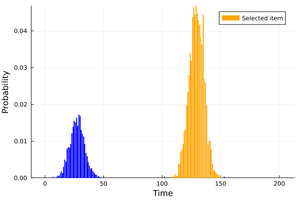

Dans le cadre de mon premier projet de thèse, j’ai étudié l’optimisation semidéfinie positive.
Published in Preprint arXiv, 2025
The min-knapsack problem with compactness constraints extends the classical knapsack problem, in the case of ordered items, by introducing a restriction ensuring that they cannot be too far apart. This problem has applications in statistics, particularly in the detection of change-points in time series. In this paper, we propose a semidefinite programming approach for this problem, incorporating compactness in constraints or in objective. We study and compare the different relaxations, and argue that our method provides high-quality heuristics and tight bounds. In particular, the single hyperparameter of our penalized semidefinite models naturally balances the trade-off between compactness and accuracy of the computed solutions. Numerical experiments illustrate, on the hardest instances, the effectiveness and versatility of our approach compared to the existing mixed-integer programming formulation.
Recommended citation: Hubert Villuendas, Mathieu Besançon and Jérôme Malick. (2025). "Knapsack with compactness: a semidefinite approach." preprint arXiv:2504.17543.
Download Paper
Published in Preprint arXiv, 2026
We consider constrained problems in which input data are affected by errors. In such settings, Wasserstein distributionally robust optimization provides a principled framework to mitigate model risk by optimizing against worst-case data distributions within Wasserstein ambiguity sets. However, the numerical resolution of the resulting problems remains challenging, especially in constrained settings. In this paper, we provide a general, practical way to solve Wasserstein distributionally robust formulations in the presence of constraints. Our approach only requires a linear minimization oracle for the feasible set, and combines two key ingredients: (i) an entropic regularization of the distributionally robust value function, which makes it possible to compute stochastic gradient estimators, and (ii) a stochastic Frank-Wolfe algorithm, which minimizes the regularized robust objective while naturally handling constraints. We illustrate the method, its tractability, and its interests against empirical risk minimization, on two operations research problems: the traffic assignment and the minimum quadratic spanning tree.
Recommended citation: Hubert Villuendas, Mathieu Besançon and Jérôme Malick. (2026). "First-Order Methods for Wasserstein Distributionally Robust Constrained Optimization." preprint arXiv:2607.11460.
Download Paper
Mis à jour :
Presentation about the min-knapsack problem, also presented on November 20, 2024 at PGMO Days 2024, Palaiseau, France. Slides
Mis à jour :
Poster session. Poster
Mis à jour :
Presentation about a Frank-Wolfe approach for Wasserstein distributionally robust optimization for combinatorial problems, also presented on February 10, 2026 at AIRO Young Workshop, Padova, Italy, and on June 2, 2026 at SIAM Conference on Optimization, Edinburgh, Scotland. Slides
M1 MoSIG, Université Grenoble Alpes, 2025
The aim of this course is to provide the necessary foundations for each student to be able to use the appropriate mathematical tools to develop well-founded reasoning and prove properties. It provides an overview of demonstration techniques, recurrence, bijections and algorithms, the basics of enumeration and combinatorics, divisibility, discrete structures and graphs, probabilities, modelling of classical laws, and random walks.
L1, Université Grenoble Alpes, 2025
Premier semestre de l’année universitaire 2025-2026 : ce cours a pour but mettre en place les objets mathématiques primordiaux qui seront ensuite utilisés en statistiques, et intelligence artificielle. En particulier, ce cours introduit les notions de probabilités discrètes et continues, la loi des grands nombres et le théorème central limite.
L1, Université Grenoble Alpes, 2026
Premier semestre de l’année universitaire 2025-2026 : ce cours a pour but mettre en place les objets mathématiques d’analyse primordiaux : notion de limite, de continuité, de dérivabilité, ainsi que le calcul intégral et la résolution des premières équations différentielles.
M1 MoSIG, Université Grenoble Alpes, 2026
The aim of this course is to provide the necessary foundations for each student to be able to use the appropriate mathematical tools to develop well-founded reasoning and prove properties. It provides an overview of demonstration techniques, recurrence, bijections and algorithms, the basics of enumeration and combinatorics, divisibility, discrete structures and graphs, probabilities, modelling of classical laws, and random walks.